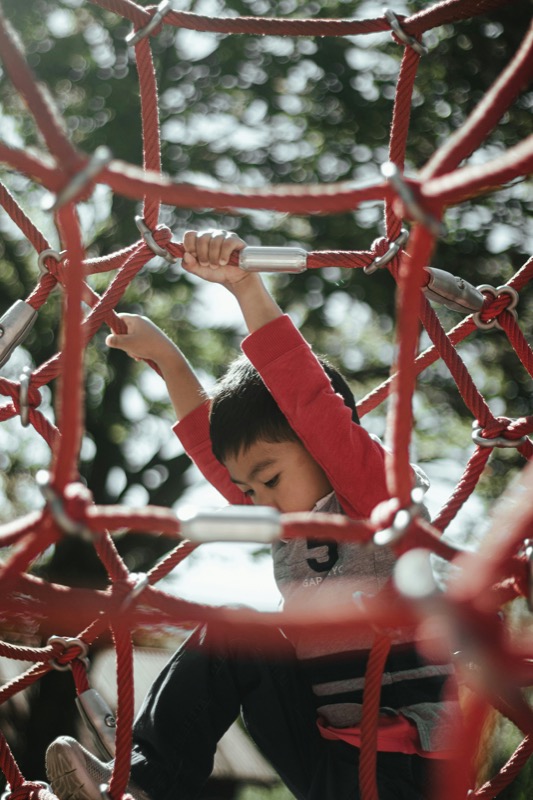
Outdoor Play
Enriched outdoor play spaces — natural elements, loose parts, varied terrain — supports kid's physical activity and wellbeing.
Ask most parents whether children should spend more time outdoors and the answer is instant: obviously yes. The intuition is almost universal, across cultures and time periods — that children belong outside, that they need space, air, and physical freedom. But the research behind that intuition is more tangled than headlines suggest, and it’s worth knowing what it actually says.
This isn’t a piece that concludes “actually, outdoor play is bad.” It isn’t. But we think parents are better served by an honest account than by inflated claims that eventually erode trust when they don’t hold up.
Key takeaways
- Enriched outdoor play environments — with varied terrain, natural elements, loose parts, and fixed structures — show positive associations with children’s physical activity. The evidence is real but heterogeneous: research can’t point to which specific feature makes the biggest difference.
- The broader case for outdoor play rests on physical activity generally (which is well-evidenced for cardiovascular and bone health), not on specifically “outdoor” benefits that have been robustly isolated.
- Research on nature-based interventions and children’s resilience or wellbeing is still in early stages — a 2025 systematic review found just one randomised controlled trial among 15 studies, and no studies at all covering children aged 7–12.
- The honest conclusion: getting children outside and into well-designed play spaces is almost certainly beneficial. We just can’t always say exactly why, how much, or which bits matter most.
- None of this should make you hesitate. The risk of too much outdoor play is extremely low.
What the playground research actually found
A 2024 systematic review, covering studies on outdoor play environment features and children’s health outcomes, produced a carefully hedged conclusion: “Although some positive effects were found, the heterogeneity between studies did not allow to draw firm conclusions on the effects of each environmental feature.”
That’s a sentence worth unpacking. It means: enriched play environments — those with natural elements, loose parts (moveable objects children can rearrange), varied terrain, and different types of fixed equipment — do seem to produce better outcomes than bare, minimal playgrounds. But the research can’t reliably tell us that adding a particular feature reliably produces a particular outcome, because the studies vary too much in design, population, and measurement.
A broader 2024 scoping review of 247 studies on outdoor play environments found that around 80% were descriptive or exploratory, with results described as “fragmented and sometimes contradictory.” This isn’t a failure of outdoor play — it’s a limitation of the research field. Designing rigorous controlled studies of playground environments is genuinely difficult.
The bottom line from the playground research: varied, interesting outdoor spaces do appear to support children being more physically active. The direction is positive. The specific mechanisms are less clear than advocates sometimes suggest.
What the nature-based intervention research found
A 2025 systematic review in Discover Mental Health (Springer Nature) examined the evidence for nature-based interventions and resilience in children and adolescents. The finding was striking for a different reason: the evidence base is extremely thin.
Of 15 studies in the review, only one was a randomised controlled trial. Three studies were rated at critical risk of bias. And — perhaps most importantly — all participants were aged 13–17. There were zero studies covering children aged 7–12, a gap the authors described as a “crucial stage for developing social functioning skills.”
This doesn’t mean nature-based interventions don’t help younger children. It means we don’t yet have good evidence either way. The 7–12 gap is an evidence gap, not a negative finding.
We include this not to dampen enthusiasm for forest schools or outdoor learning programmes, but because we think parents should know when something is supported by strong evidence versus when it’s a promising approach that hasn’t yet been rigorously studied. The honest answer here is: we don’t know yet, and more research is needed.
What we do know, and why it still matters
The case for outdoor play doesn’t collapse if the specifically “outdoor” benefit claims turn out to be harder to isolate than enthusiasts hoped. Here’s what remains solid:
Physical activity is good for children. This is well-established consensus from the WHO and major national health bodies worldwide. Physical activity is associated with better cardiovascular health, stronger bones and muscles, and reduced chronic disease risk. Outdoor play — particularly in varied environments — tends to produce more physical activity than indoor sedentary time. That alone is reason to prioritise it.
Children need unstructured time. The case for unstructured outdoor play isn’t just about physical activity. It’s about opportunities for self-directed exploration, risk management, social negotiation, and imagination. These are claims that are harder to study rigorously, but they’re not therefore false — they reflect longstanding observations from developmental psychology.
The risk-benefit calculation is clear. Even if we can’t quantify every benefit, the risks of children spending too much time outdoors in safe environments are minimal. The precautionary principle runs in the other direction here: the downside of outdoor play is low; the potential upside is real.
What makes a good outdoor environment
Based on the playground research, the features most consistently associated with increased physical activity include:
- Varied terrain — hills, uneven surfaces, natural contours rather than flat asphalt
- Natural elements — trees, grass, water features, rocks, soil
- Loose parts — moveable objects children can pick up, carry, rearrange (crates, tyres, logs, sand, buckets)
- Fixed structures — climbing frames, slides, and equipment, particularly when varied in height and challenge level
- Social spaces — areas where children can gather, hide, and create games together, rather than pure activity equipment
The key pattern across the research is that variety and choice seem to matter more than any single feature. A playground that offers multiple different ways to move, explore, and play tends to produce more active, more engaged children than one optimised for a single activity.
Getting children outside: practical reality
Most of the factors that determine whether children get outdoor time aren’t about playground design — they’re about parental permissions, local safety, traffic, and screen time competition.
A few things that the evidence on physical activity (and developmental psychology more generally) suggests:
- Regularity matters more than intensity. Short daily outdoor time probably does more than occasional longer outings.
- Self-direction matters. Children who are free to explore, decide, and take small risks tend to be more active and engaged than those doing adult-directed outdoor activities.
- Screen competition is real. The research on outdoor play decline is complicated by study quality, but the practical reality that screens compete powerfully for children’s time and attention isn’t in dispute.
- Tolerance of mess and minor risk is part of the deal. The kinds of outdoor environments that seem most beneficial — varied, natural, involving loose parts — are also muddier and more unpredictable.
Forest schools and nature-based learning
Forest schools and nature-based early years programmes have grown substantially in the UK, Australia, Scandinavia, and beyond. The philosophy — that children benefit from regular, sustained contact with natural outdoor environments — is widely held by practitioners and parents who have seen it in action.
The formal research base for these programmes is, as noted above, still developing. What we can say:
- Practitioners and educators working in these settings report observing genuine benefits in children’s confidence, risk tolerance, and social skills
- The physical activity element of forest school settings is clearly beneficial
- For early years children especially, outdoor learning environments provide sensory and exploratory experiences that indoor settings can’t replicate
Whether the specifically “nature” element produces benefits over and above the physical activity, social interaction, and self-direction elements is not yet well-established by research. That’s worth knowing — but it’s not a reason to dismiss programmes that seem to be working in practice.
A note on evidence and trust
We’ve tried in this piece to be honest about what the research shows and doesn’t show. Some of what circulates about outdoor play — dramatic statistics about play declining by 50%, nature-based interventions producing large resilience gains — didn’t survive the adversarial fact-checking we applied when researching this piece.
We think that honesty is a feature, not a bug. If we tell you things that turn out not to be true, you’ll eventually stop trusting us. The genuine case for outdoor play is strong enough that it doesn’t need to be overstated.